
Quartz vs Porcelain Countertops: Key Differences for Houston & Austin Homes
Quartz vs Porcelain Countertops: Which Is Better for Kitchens and Bathrooms?
When planning a kitchen or bathroom renovation, one of the most common questions homeowners ask is whether quartz countertops or porcelain countertops are the better option. Both materials are modern, durable, and visually stunning, but they are manufactured very differently and perform differently depending on the application.
For homeowners in Houston and Austin, choosing the right countertop material can make a significant difference in durability, maintenance, and long-term value.
At iGranite, we regularly help homeowners compare quartz and porcelain slabs in person to determine which surface works best for their kitchen, bathroom, or outdoor project.
What Are Quartz Countertops?
Quartz countertops are an engineered stone surface made from approximately 90–95% natural quartz crystals combined with resins and pigments. The materials are compressed under high pressure to create a dense and non-porous slab.
Because quartz is engineered, manufacturers can create consistent colors, patterns, and marble-inspired designs such as Calacatta styles.
Benefits of Quartz Countertops
Non-porous surface
Highly stain resistant
Does not require sealing
Consistent patterns and colors
Durable for daily kitchen use
Available in thick slabs (2cm and 3cm)
Quartz is one of the most popular materials for kitchen countertops in Houston and Austin because it combines durability with low maintenance.
What Are Porcelain Countertops?
Porcelain countertops are a high-performance ceramic surface made from refined clay, silica, feldspar, and mineral oxides that are fired at extremely high temperatures.
The manufacturing process creates a very dense and heat-resistant slab that performs well in kitchens, bathrooms, and outdoor environments.
Unlike quartz, porcelain designs are usually printed onto the slab surface using advanced digital printing technology, allowing manufacturers to replicate marble, concrete, metal, and natural stone looks.
Benefits of Porcelain Countertops
Extremely heat resistant
UV resistant (ideal for outdoor kitchens)
Scratch resistant
Non-porous surface
Lightweight compared to stone
Large slab formats available
Porcelain has become increasingly popular for modern kitchens and outdoor spaces in Texas because of its durability and ability to handle extreme heat.
Major Differences Between Quartz and Porcelain Countertops
Material Composition
Quartz
Engineered stone
Natural quartz combined with resins
Pattern runs throughout the slab
Porcelain
Ceramic material
Made from clay and minerals fired in kilns
Pattern typically printed on the surface
Thickness and Edge Fabrication
Quartz slabs typically come in 2cm or 3cm thickness, allowing edges to be fabricated directly from the slab (unless it is a printed quartz).
Porcelain slabs are usually 6mm–12mm thick, which means edges often require miter fabrication to create the appearance of a thicker countertop.
Heat Resistance
Quartz is heat resistant but not heat proof because the resin binders can be damaged by extreme temperatures.
Porcelain is manufactured at temperatures exceeding 2,000°F, making it one of the most heat-resistant countertop materials available.
Winner: Porcelain
Scratch Resistance
Both materials are very durable, but porcelain’s ceramic composition makes it extremely resistant to scratches.
Quartz is also highly scratch resistant but can occasionally show marks from sharp objects.
Winner: Slight advantage to porcelain
UV Resistance and Outdoor Use
Quartz is not recommended for outdoor kitchens because prolonged UV exposure can discolor the resin.
Porcelain is completely UV resistant, making it an excellent choice for outdoor kitchens, BBQ areas, and exterior installations.
Winner: Porcelain
Maintenance Requirements
Both quartz and porcelain are non-porous materials, which means they do not require sealing like granite or marble.
Routine cleaning only requires:
Mild soap
Water
Non-abrasive cleaners
Winner: Tie
Quartz vs Porcelain Countertops Comparison
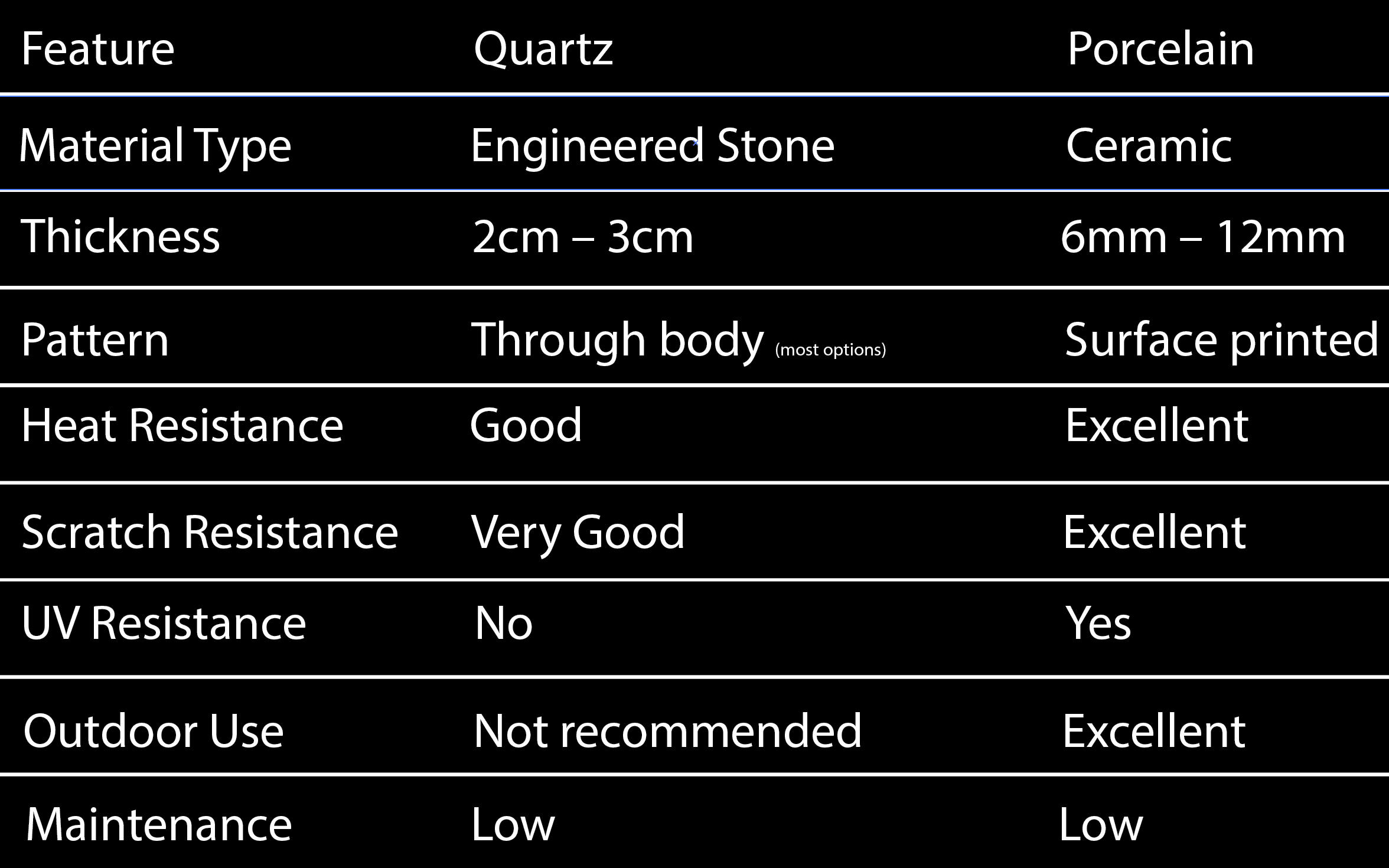
Which Countertop Is Better?
The better countertop depends on how the material will be used.
Quartz Is Best For
Residential kitchens
Bathroom vanities
Large islands
Thick stone edge profiles
Low maintenance surfaces
Porcelain Is Best For
Outdoor kitchens
Heat-heavy cooking environments
Shower walls and feature walls
Modern minimalist kitchens
Lightweight installations
Both materials offer outstanding durability and style, but the right choice depends on design goals, installation requirements, and how the surface will be used.
View material sampels in person
Homeowners throughout Houston and Austin visit iGranite to explore quartz, porcelain, granite, quartzite, and marble countertop options for kitchens and bathrooms.
📍 iGranite Showroom
1808 W Sam Houston Pkwy N
Houston, TX 77043
📞 (281) 698-7378
Explore the largest selection of countertop materials and cabinets for kitchen and bathroom remodels.
FAQ
Are porcelain countertops better than quartz?
Porcelain countertops are more heat and UV resistant than quartz, making them ideal for outdoor kitchens. Quartz countertops offer thicker slabs and deeper patterns, which many homeowners prefer for indoor kitchens.
Do porcelain countertops scratch easily?
Porcelain countertops are highly scratch resistant due to their ceramic composition. They are one of the most durable countertop materials available.
Can quartz countertops handle heat?
Quartz countertops are heat resistant but not heat proof. Using trivets or hot pads is recommended to protect the surface from extreme temperatures.
Are porcelain countertops good for outdoor kitchens?
Yes. Porcelain is UV resistant and can withstand sun exposure without fading, making it ideal for outdoor kitchen countertops.
Which countertop is easier to maintain?
Both quartz and porcelain countertops are non-porous and require minimal maintenance. Routine cleaning with soap and water is usually sufficient.
Quartz Sample Gallery
https://www.houstongranitecountertops.com/product-samples/quartz
Porcelain Sample Gallery
https://www.houstongranitecountertops.com/product-samples/porcelain